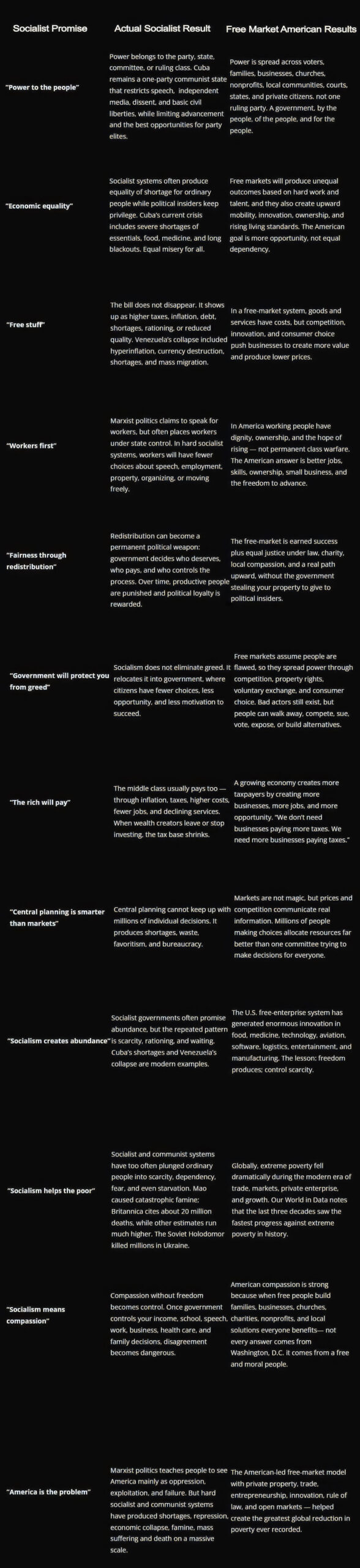
Socialist promise Actual socialist results Free-market American results
“Power to the people”


Power belongs to the party, state, committee, or ruling class. Cuba remains a one-party communist state that restricts speech,  independent media, dissent, and basic civil liberties, while limiting advancement and the best opportunities for party elites. 


Power is spread across voters, families, businesses, churches, nonprofits, local communities, courts, states, and private citizens. not one ruling party. A government, by the people, of the people, and for the people.

“Economic equality”


Socialist systems often produce equality of shortage for ordinary people while political insiders keep privilege. Cuba’s current crisis includes severe shortages of essentials, food, medicine, and long blackouts. Equal misery for all.


Free markets will produce unequal outcomes based on hard work and talent, and they also create upward mobility, innovation, ownership, and rising living standards. The American goal is more opportunity, not equal dependency.

“Free stuff”


The bill does not disappear. It shows up as higher taxes, inflation, debt, shortages, rationing, or reduced quality. Venezuela’s collapse included hyperinflation, currency destruction, shortages, and mass migration.


In a free-market system, goods and services have costs, but competition, innovation, and consumer choice push businesses to create more value and produce lower prices.

“Workers first”


Marxist politics claims to speak for workers, but often places workers under state control. In hard socialist systems, workers will have fewer choices about speech, employment, property, organizing, or moving freely.


In America working people have dignity, ownership, and the hope of rising — not permanent class warfare. The American answer is better jobs, skills, ownership, small business, and the freedom to advance.

“Fairness through redistribution”


Redistribution can become a permanent political weapon: government decides who deserves, who pays, and who controls the process. Over time, productive people are punished and political loyalty is rewarded.


The free-market is earned success plus equal justice under law, charity, local compassion, and a real path upward, without the government stealing your property to give to political insiders.

“Government will protect you from greed”


Socialism does not eliminate greed. It relocates it into government, where citizens have fewer choices, less opportunity, and less motivation to succeed.


Free markets assume people are flawed, so they spread power through competition, property rights, voluntary exchange, and consumer choice. Bad actors still exist, but people can walk away, compete, sue, vote, expose, or build alternatives.

“The rich will pay”


The middle class usually pays too — through inflation, taxes, higher costs, fewer jobs, and declining services. When wealth creators leave or stop investing, the tax base shrinks.


A growing economy creates more taxpayers by creating more businesses, more jobs, and more opportunity. “We don’t need businesses paying more taxes. We need more businesses paying taxes.”

“Central planning is smarter than markets”


Central planning cannot keep up with millions of individual decisions. It  produces shortages, waste, favoritism, and bureaucracy.


Markets are not magic, but prices and competition communicate real information. Millions of people making choices allocate resources far better than one committee trying to make decisions for everyone.

“Socialism creates abundance” Socialist governments often promise abundance, but the repeated pattern is scarcity, rationing, and waiting. Cuba’s shortages and Venezuela’s collapse are modern examples. The U.S. free-enterprise system has generated enormous innovation in food, medicine, technology, aviation, software, logistics, entertainment, and manufacturing. The lesson: freedom produces; control scarcity.
“Socialism helps the poor”


Socialist and communist systems have too often plunged ordinary people into scarcity, dependency, fear, and even starvation. Mao  caused catastrophic famine; Britannica cites about 20 million deaths, while other estimates run much higher. The Soviet Holodomor killed millions in Ukraine.


Globally, extreme poverty fell dramatically during the modern era of trade, markets, private enterprise, and growth. Our World in Data notes that the last three decades saw the fastest progress against extreme poverty in history.

“Socialism means compassion”


Compassion without freedom becomes control. Once government controls your income, school, speech, work, business, health care, and family decisions, disagreement becomes dangerous.


American compassion is strong because when free people build families, businesses, churches, charities, nonprofits, and local solutions everyone benefits— not every answer comes from Washington, D.C. it comes from a free and moral people.

“America is the problem”


Marxist politics teaches people to see America mainly as oppression, exploitation, and failure. But hard socialist and communist systems have produced shortages, repression, economic collapse, famine, mass suffering and death on a massive scale.


The American-led free-market model with private property, trade, entrepreneurship, innovation, rule of law, and open markets — helped create the greatest global reduction in poverty ever recorded.